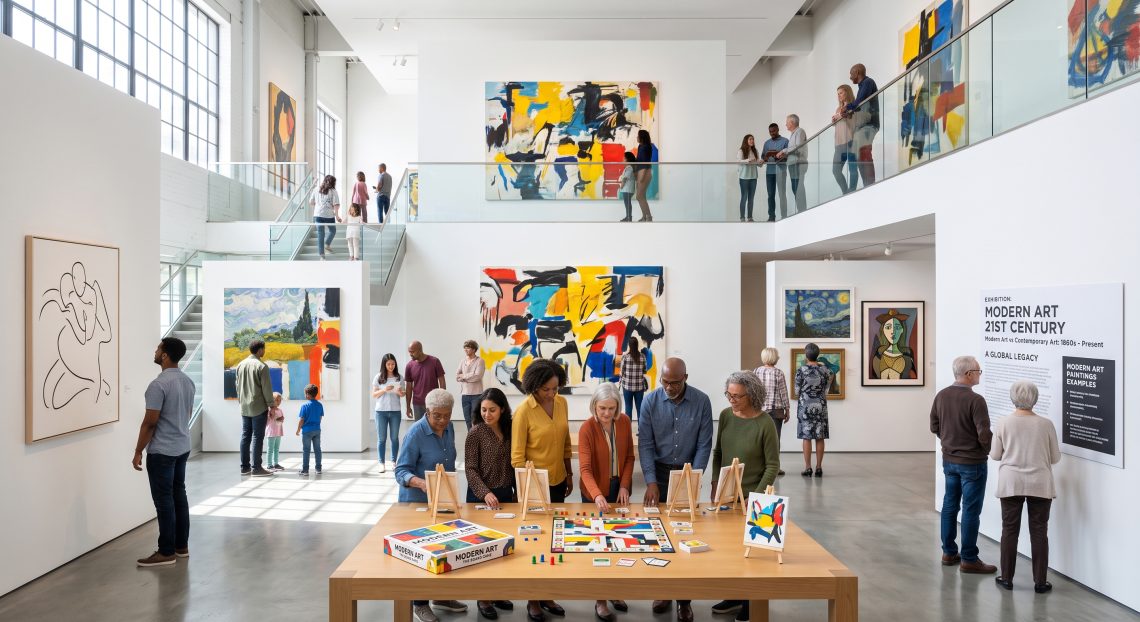
The Essential Guide to Modern Art: History, Masterpieces, and Global Impact
Modern art represents one of the most transformative eras in cultural history, completely rewriting the rules of visual expression. Spanning roughly from the 1860s through the 1970s, this dynamic period abandoned rigid academic traditions in favor of experimentation, personal vision, and conceptual freedom. Rather than merely recording reality like a camera, artists began exploring how color, shape, emotion, and philosophical inquiry could reshape human perception.
Understanding this revolution reveals how our visual world evolved into what it is today. From pioneering canvases to vibrant digital expressions, exploring the movement clarifies the techniques, philosophical shifts, and iconic works that continue to redefine visual creativity.
What Is Modern Art?
At its core, modern art refers to the artistic output, philosophies, and movements developed during an era of radical industrial, scientific, and social change. Beginning in late 19th-century Europe—most notably in Paris—painters and sculptors broke away from state-sponsored academies that prioritized mythological subjects, historical narratives, and photorealistic precision.
Instead, modernists embraced subjectivity. Influenced by rapid urbanization, psychological discoveries by figures like Sigmund Freud, and the invention of photography, creators asked a fundamental question: If a photograph can perfectly replicate a scene, what is the true purpose of art? The answer lay in the artist’s internal world—their emotional response, formal experimentation, and intellectual perspective.
Iconic Modern Art Paintings and Masterpieces
The evolution of modernist aesthetics can be traced directly through pivotal canvases that challenged public taste and set new visual benchmarks:
-
Édouard Manet, Le Déjeuner sur l’herbe (1863): Often cited as the catalyst for modernism, this painting scandalized the Paris Salon by juxtaposing a fully nude female figure alongside clothed, contemporary men in an ordinary outdoor setting, deliberately rejecting academic gloss.
-
Vincent van Gogh, The Starry Night (1889): Van Gogh turned landscapes into emotional territory through swirling impasto, vivid cobalt blues, and radiant yellows, illustrating that internal passion outweighs literal observation.
-
Pablo Picasso, Les Demoiselles d’Avignon (1907): A revolutionary breakthrough in modern art paintings, Picasso deconstructed five female figures into jagged, fractured planes influenced by Iberian and African masks, launching the Cubist movement.
-
Claude Monet, Water Lilies series (c. 1914–1926): Monet’s late-career examinations of light and atmospheric reflection dissolved fixed horizons, serving as an essential bridge toward complete abstraction.
-
Salvador Dalí, The Persistence of Memory (1931): With its melting clocks draped across a desolate dreamscape, this masterpiece brought Surrealist inquiries into memory and the unconscious mind into mainstream culture.
Major Modern Art Examples Across Key Movements
Modernism was never a single aesthetic; it was an umbrella of diverse, rapidly evolving movements. Prominent modern art examples demonstrate how distinct artistic philosophies developed:
| Movement | Defining Characteristics | Key Figures | Iconic Example |
| Impressionism | Fleeting daylight, loose brushwork, plein-air scenes | Claude Monet, Edgar Degas | Impression, Sunrise |
| Post-Impressionism | Expressive color, structural geometry, emotional symbolism | Paul Cézanne, Vincent van Gogh | Mont Sainte-Victoire |
| Cubism | Deconstructed perspectives, geometric facets, multiple viewpoints | Pablo Picasso, Georges Braque | Guernica |
| Surrealism | Dream logic, unconscious symbolism, illogical juxtapositions | Salvador Dalí, René Magritte | The Treachery of Images |
| Abstract Expressionism | Gestural brushwork, monumental scale, pure chromatic energy | Jackson Pollock, Mark Rothko | No. 5, 1948 |
Modern Art Abstract: The Journey to Non-Objective Art
The development of modern art abstract expression represents modernism’s boldest philosophical leap. Pioneering painters systematically stripped away recognizable figures, landscapes, and objects to let line, color, and texture speak autonomously.
Wassily Kandinsky, widely recognized as one of the earliest pioneers of pure abstraction, believed color resonated with spiritual and musical frequencies. In works like Composition VII (1913), canvas space became an explosion of rhythmic color disconnected from physical reference points. Meanwhile, Piet Mondrian and the De Stijl movement took abstraction toward harmonious geometry, employing primary colors bordered by black grids to discover universal equilibrium. By mid-century, Abstract Expressionists split into two influential camps: the dynamic, athletic “action painting” of Jackson Pollock and the contemplative, atmospheric Color Field paintings of Mark Rothko.
The Expressive Freedom of Modern Art Drawing
While canvas paintings often dominate gallery walls, the world of modern art drawing was equally groundbreaking. Modernists ceased using drawing solely as a preparatory sketch for “finished” oil paintings, elevating works on paper into complete, standalone expressions.
Drawing became an arena for spontaneous thought and radical reduction:
-
Contour and Line: Henri Matisse turned line drawing into an economy of absolute grace, using minimalist, continuous ink lines to capture the human form with minimal strokes.
-
Automatic Drawing: Surrealists like Joan Miró and André Masson practiced automatism—allowing the hand to glide freely without conscious control—to unlock the raw art imagery of the subconscious mind.
-
Constructive Charcoal and Graphite: Egon Schiele and Käthe Kollwitz wielded drawing instruments with raw, abrasive intensity, using stark linework to communicate existential vulnerability and social upheaval.
Modern Art vs Contemporary Art: Clearing the Confusion
Museum visitors and collectors frequently conflate modernism with contemporary works. However, the distinction between modern art vs contemporary art is defined by specific chronological boundaries and thematic priorities:
[c. 1860s] ──────── Modern Art Era ──────── [c. 1970] ──────── Contemporary Art Era ──────── [Present Day]
            • Focus: Medium, form, personal vision      • Focus: Identity, global issues, multimedia
            • Movements: Cubism, Surrealism, AbEx       • Forms: Installation, digital art, social practice
-
Timeline: Modern art encompasses works produced from roughly the 1860s through the late 1960s or 1970s. Contemporary art covers works produced from approximately 1970 to the present day.
-
Aesthetic Focus: Modernist masters explored the boundaries of artistic mediums (paint on flat canvas, sculptured stone, raw line). Contemporary creators frequently prioritize concepts over medium, utilizing installations, performance, conceptual structures, and digital media.
-
Thematic Scope: While modern art reflected industrialization, psychological identity, and formal aesthetics, contemporary art grapples with globalization, digital interconnectedness, environmental activism, and identity politics.
Modern Art in the 21st Century: Lasting Cultural Legacy
Even as art historians categorize modernism as a finished historical era, the spirit of modern art 21st century culture continues to thrive. Today’s creators frequently dialogue with historical modernist techniques, reinterpreting mid-century color theory, constructivism, and gestural painting through fresh technological lenses.
Museums worldwide—from MoMA in New York to the Tate Modern in London—continue breaking attendance records with retrospectives of modern masters. Contemporary painters routinely cite Picasso’s spatial deconstruction and Rothko’s chromatic scale as the baseline of their own creative practices, demonstrating that the breakthroughs made over a century ago remain vital.
Beyond the Canvas: The Modern Art Board Game
Modernism’s widespread fascination is not confined to gallery corridors; it has entered tabletop culture through the acclaimed modern art board game created by master designer Reiner Knizia.
First released in 1992 and republished in lavish editions featuring real-world contemporary paintings, Modern Art casts 3 to 5 players as rival art gallery curators. Players buy and auction artworks through five distinct bidding formats—open auctions, hidden bids, fixed-price sales, sealed bids, and double auctions. As certain artists’ works sell, their market values climb or crash, capturing the speculative economy, prestige, and high-stakes drama of the fine art world. It stands as an inventive bridge between fine art appreciation and strategic tabletop gameplay.
Why Famous Modern Art Still Captivates Audiences
Ultimately, the enduring appeal of famous modern art stems from its invitation to step inside the artist’s perspective. By abandoning strict visual conformity, modernist innovators proved that art does not need to reproduce reality to reveal profound truths about existence.
Whether examining a vibrant modern art abstract composition, studying an intimate modern art drawing, or analyzing the shifting definitions between modern art vs contemporary art, exploring this creative epoch reminds us that imagination is limitless when we dare to look beyond the surface.